

Free embodied carbon calculator
Your project's embodied carbon,
estimated in minutes.
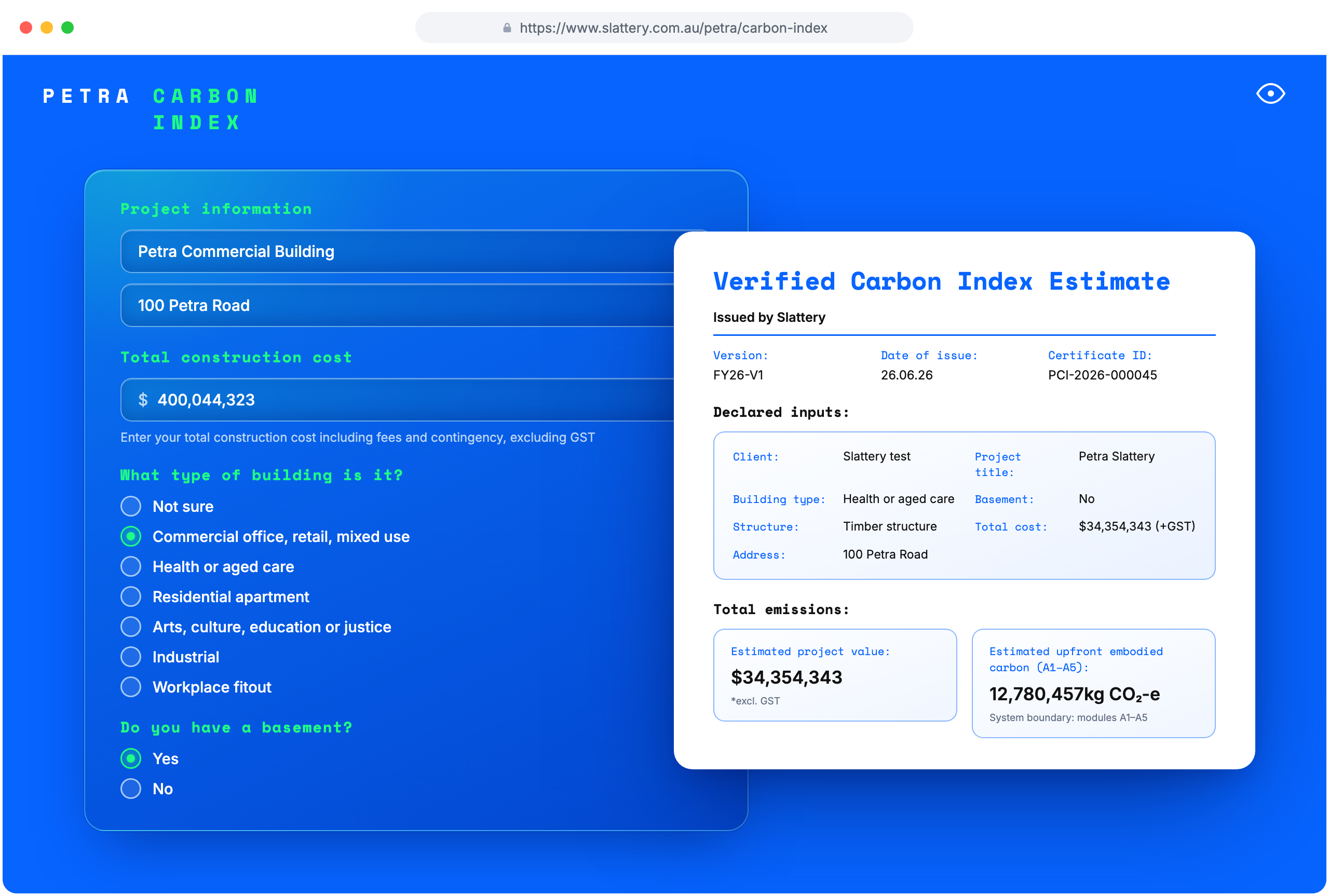
Enter your project cost and building type to get an embodied carbon estimate built on verified Australian construction data. No specialist knowledge required.
THREE STEPS
From a project cost to
a credible first estimate
No emissions factors to look up and no spreadsheets. If you know your project cost, you can run it.
01
02
03
A number you can actually work from
The Carbon Index gives you an embodied carbon estimate for your project, built on a transparent methodology and Australian project data.
- Total embodied carbon in kg CO₂e for your project
- A transparent methodology, verified and maintained by Slattery
- Built on verified Australian construction data rather than overseas averages
- Early enough to act on, while design and material decisions are still open
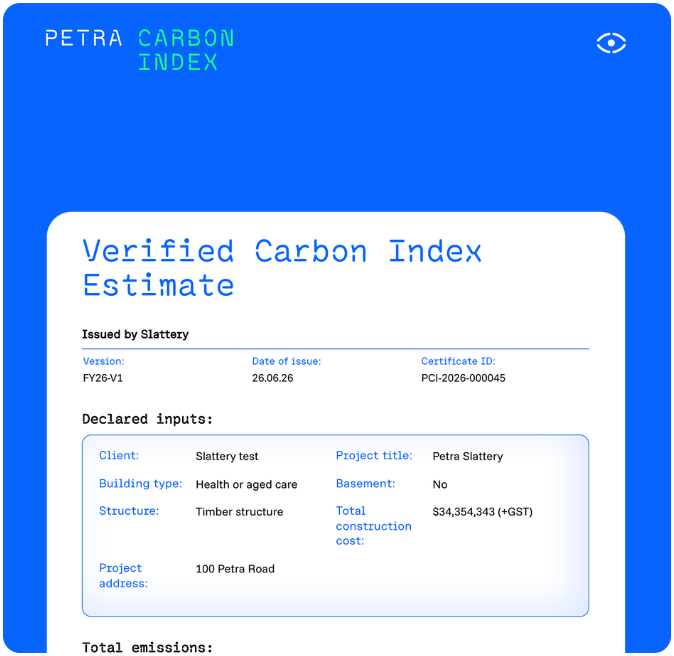
- Sent to your inbox, so you can share it with your team or advisors
Climate reporting requirements are expanding
As climate reporting obligations widen, more organisations need construction emissions numbers earlier than a detailed assessment can provide them. For organisations delivering construction projects, embodied carbon can be a material part of that picture.The Carbon Index gives you a credible first estimate for exactly those moments, when detailed measurement isn't practical yet but you still need a number to work from and act on.
Expanding
Early
Minutes
Beyond the estimate
Now you have a number.
Next, bring it down.
Knowing your embodied carbon is the starting point. The value is in what you change because of it, and that's where Slattery's team works with you.
Talk to Slattery
Bring us your project and our advisors help you find where the carbon actually sits and what reduces it, from structural options and material choices to comparing design scenarios before they're locked in.
- See which choices move the number, and by how much
- Compare design and material options early, while change is still cheap
- Advice from a team that's spent decades in Australian construction
The Carbon Index is a free early-stage estimate. Carbon reduction advice and customisation are Slattery advisory services.
What is AASB S2?
AASB S2 is Australia's mandatory climate-related disclosure standard. It requires reporting entities to disclose climate-related risks and opportunities that could reasonably be expected to affect their cash flows, access to finance or cost of capital, covering governance, strategy, risk management and metrics.
Those metrics include greenhouse gas emissions. Reporting entities are required to disclose absolute gross Scope 1, Scope 2 and Scope 3 emissions, and for organisations that build, a significant share of Scope 3 sits in the materials and delivery of construction projects.
Whether you report depends on thresholds under the Corporations Act, including size criteria across revenue, assets and employees, and whether you're an NGER reporter. ASIC Regulatory Guide 280 sets out the detail.
AASB S1 and AASB S2 are often referred to together. They're the two Australian Sustainability Reporting Standards: AASB S1 covers sustainability-related financial information more broadly and is voluntary, while AASB S2 covers climate specifically and is the mandatory one. For construction emissions, AASB S2 is the standard that matters.
Who reports, and when
Annual periods from 1 Jan 2025
Annual periods from 1 Jul 2026
Annual periods from 1 Jul 2027
Group criteria and thresholds are set out in ASIC Regulatory Guide 280 and the AASB S2 Knowledge Hub. This summary is general information, not advice on your reporting obligations.
Before you ask
The honest answers
Q
Is it really free?
Yes, the Carbon Index is free to use. No card and no trial that expires. You enter your name, email and organisation to get access, and your estimate is sent to that email address.
Q
How accurate is a cost-based estimate?
It's an early-stage estimate built on Australian real-project datasets and verified by Slattery. It's built for the point in a project where you need a credible carbon number before detailed measurement is available.
Q
Can I use it for mandatory climate reporting?
Talk to us about your reporting obligations and we'll tell you where the estimate fits. Whether an estimate can be used in mandatory reporting depends on your reporting boundary and your assurance requirements.
Q
What is AASB S2?
It's Australia's mandatory climate-related disclosure standard. It requires reporting entities to disclose climate-related risks and opportunities alongside governance, strategy, risk management and metrics, including Scope 1, 2 and 3 greenhouse gas emissions.
Q
Who has to report under AASB S2, and when?
Reporting is phased in three groups: Group 1 from annual periods beginning 1 January 2025, Group 2 from 1 July 2026, and Group 3 from 1 July 2027. Which group you fall into depends on size thresholds and NGER status. ASIC Regulatory Guide 280 has the criteria.
Q
What's the difference between AASB S1 and AASB S2?
AASB S1 covers sustainability-related financial information generally and is voluntary. AASB S2 covers climate-related disclosures and is mandatory for entities that meet the reporting thresholds. There is no AASB S3.
Q
Why does embodied carbon matter for AASB S2 reporting?
AASB S2 requires disclosure of Scope 3 emissions, and for organisations that build, a significant share of Scope 3 sits in construction materials and delivery. That's the part hardest to quantify early, which is where an estimate helps.
Q
What happens to my project data?
You get your estimate on screen and by email. Nothing is published or shared. See Slattery's privacy policy before entering anything sensitive.
Q
Who built this?
Slattery, who've spent decades advising on Australian construction cost and delivery. The methodology comes from that practice, not a generic global model.
